West Africa’s pepper economy is expanding, but not everywhere in the same way
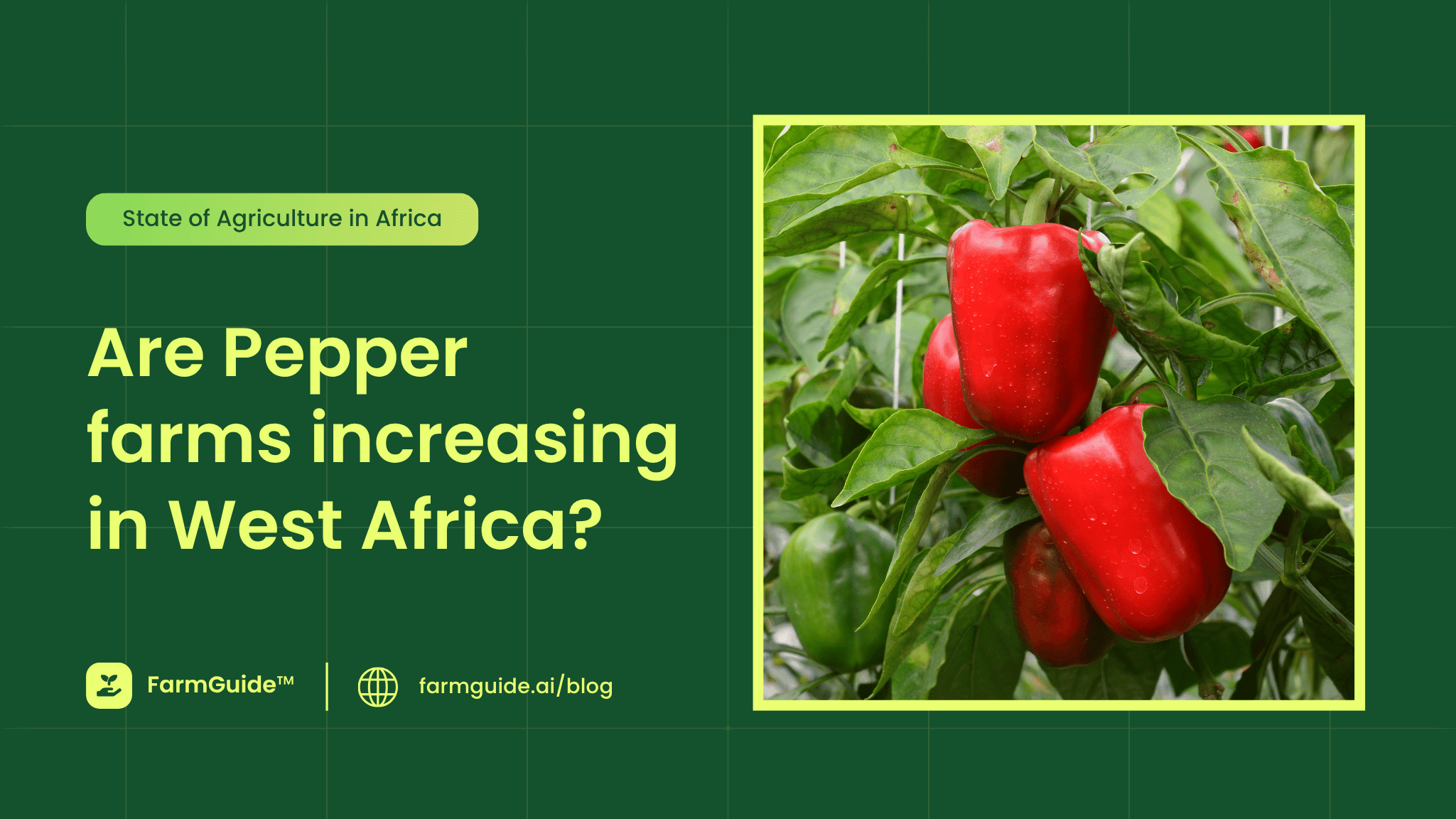
Benin’s production surge, Nigeria’s scale, and Ghana’s export systems show why market readiness matters as much as acreage.
Pepper is difficult to miss in West African food markets. It is sold fresh in baskets, dried in sacks, milled into powder and blended into sauces used every day. That visibility can make it easy to assume that one pepper boom is spreading across the region.
The evidence is more uneven, and more useful.
Across Nigeria, Ghana and Benin, pepper production is not following one regional path. Benin has recorded a clear expansion in harvested area, output and yield. Nigeria remains the largest producer of the three, but its growth has been gradual. Ghana’s official figures are broadly stable, even as the country has built a more organised export segment around chilli pepper.
For farmers and agricultural businesses, the distinction matters. A crop can become more visible without a large increase in national output. Production can rise because more land is planted, because yields improve, or because both change together. None of those trends, on its own, guarantees that an individual farm will be profitable.
What the production data shows
FAOSTAT reports green and dry chillies and peppers as broad commodity groups. These categories include different Capsicum and Pimenta types, so they do not separate every local variety or market name. The figures are still useful for comparing the direction of production, harvested area, and yield across countries.
For a comparable production window, this article uses 2014 to 2023 country-level figures. FAO’s agricultural production domain now includes data up to 2024, but the 2014 to 2023 window is retained here to keep the country comparison consistent.
Between 2014 and 2023, the data shows three distinct patterns:
- Benin: Green chilli and pepper production rose from about 76,000 tonnes to 134,000 tonnes. Harvested area increased from roughly 28,100 hectares to 39,700 hectares, while yield improved from 2.7 to 3.4 tonnes per hectare.
- Nigeria: Green chilli and pepper production increased from about 743,000 tonnes to 775,000 tonnes. Harvested area grew from about 97,300 hectares to 104,800 hectares, while estimated yield declined slightly. Dry chilli and pepper production also rose, from about 60,500 tonnes to 64,900 tonnes.
- Ghana: Green chilli and pepper production remained close to 122,000 to 124,000 tonnes. Harvested area changed little, while estimated yield was broadly flat. Ghana’s Ministry of Food and Agriculture reports a similarly steady pattern for chilli area, at approximately 14,000 to 16,000 hectares between 2014 and 2022.
The quality of the evidence also differs. Benin’s series is largely reported as official data. Several Nigeria and Ghana observations in FAOSTAT are marked as imputed or estimated. This does not make them unusable, but it means the exact values should be read as directional rather than definitive.
Benin shows the clearest production rise
Among the three countries, Benin provides the strongest evidence for a genuine rise in pepper farming. From 2014 to 2023, production increased by about 77 percent, harvested area by 41 percent and yield by 25 percent. Growth therefore came from both expansion and better output per hectare.
The country’s agricultural statistics authority also reported 134,120 tonnes of pepper in the 2023 to 2024 season. That was only 0.5 percent above the preceding season, which suggests that rapid expansion has recently slowed. Even so, output remained well above the five-year average of 117,080 tonnes.
This is an important distinction. Benin’s longer-term trend is strong, but the latest annual movement is modest. Farmers considering entry still need current local price information, a realistic production budget, and a defined sales channel. National growth does not remove the risk of seasonal oversupply in a particular market.
Nigeria offers scale, not a sudden boom
Nigeria is the largest pepper producer in this comparison by a wide margin. Its domestic market is deep, and the National Agricultural Sample Survey distinguishes sweet or bell pepper, small pepper and chilli pepper in household production data. That variety reflects the different ways pepper is grown, traded and consumed across the country.
Yet the national production series does not show a dramatic surge. Green pepper output rose by about 4 percent between 2014 and 2023, while harvested area increased by about 8 percent. The estimated yield moved in the opposite direction, falling by about 3 percent. Dry pepper performed somewhat better, but the overall pattern remains one of gradual expansion.
Nigeria’s opportunity lies in the size and diversity of its market. Farmers can supply open markets, aggregators, restaurants, processors and exporters, but each channel values a different combination of variety, colour, pungency, size, moisture level, appearance and consistency. A producer who plants before understanding those requirements may discover that strong demand for pepper does not mean strong demand for every pepper.
Post-harvest handling is another constraint. The World Vegetable Center notes that Nigerian vegetable farmers face limited access to improved seed, climate-resilient production practices and post-harvest technologies. These weaknesses contribute to losses before produce reaches consumers. For a perishable crop, the commercial result depends on how quickly harvest is sorted, packed, moved and sold.
Ghana’s story is about market organisation
Ghana’s production figures are stable, but the country’s pepper sector remains commercially important. The Ghana Export Promotion Authority describes chilli pepper as a leading vegetable export, with established links to buyers in the United Kingdom, France, the Netherlands and Germany. It also points to producer-exporter networks and outgrower arrangements designed to support consistent supply.
This helps explain why a crop can appear to be rising even when national output barely changes. Better organised exporters, visible certification programmes, contract relationships and stronger market communication can increase commercial activity without producing a large shift in total tonnage.
Ghana’s experience also shows the cost of weak compliance. Chilli pepper was among the plant products restricted from the European Union market after phytosanitary concerns. The restriction was lifted for 2018 after corrective measures, but exporters still had to meet European plant-health rules. Market access can be won, lost and rebuilt.
For farmers targeting formal buyers, quality must be planned before planting. Export-oriented channels may require traceability, residue management, phytosanitary controls, grading, packaging and certification. Domestic processors may care more about pungency, colour, dryness, cleanliness and reliable volumes. The buyer’s specification determines the production system.
Why farmers continue to consider pepper
Pepper remains attractive because demand is broad and the crop can serve several markets. Fresh produce can move quickly into local and urban wholesale channels. Dried pepper has a longer selling window when it is dried safely and protected from moisture and contamination. Processors can turn suitable varieties into powders, pastes, sauces and seasoning blends.
These channels create options, but they are not interchangeable. A variety selected for fresh retail may not deliver the colour, heat or dry-matter content a processor wants. An exporter may reject produce that a local market accepts. A farmer therefore needs more than a general belief that people eat pepper.
Before committing land and capital, a prospective producer should answer five questions:
- Which pepper type and variety does the intended buyer want?
- What quantity, grade and delivery schedule can the farm supply consistently?
- What is the full cost per kilogram after seed, labour, irrigation, crop protection, packaging, transport and losses?
- How will harvested pepper be cooled, sorted, dried or moved before quality declines?
- What is the alternative market if the first buyer does not purchase as planned?
The same discipline applies to exporters. Nigeria’s Export Promotion Council lists phytosanitary certification for agricultural commodities among the documents needed for export, alongside inspection, weight and quality records where applicable. Ghana’s market guidance similarly emphasises good agricultural practice, food safety and post-harvest control. These are operating requirements, not paperwork to assemble after harvest.
The real opportunity is coordination
West Africa’s strongest pepper opportunity lies in connecting production decisions with verified demand, not in expanding acreage without a market plan.
Farmers need current information about buyers, prices, preferred varieties, and delivery terms. Buyers need reliable visibility into location, expected harvest, volume and production practices. Aggregators and processors need enough coordination to assemble consistent lots without losing quality along the way.
The evidence from Nigeria, Ghana and Benin points to a regional pepper economy with substantial scale and clear commercial potential. It also shows that growth is uneven. Benin has delivered the strongest production expansion. Nigeria brings market depth and large volumes. Ghana demonstrates how export organisation and compliance can make a stable production base more commercially visible.
For a farmer, the practical lesson is straightforward: choose the market before choosing the seed. Pepper can be a viable enterprise when production, quality and sales are planned as one system. It becomes far riskier when planting begins with demand assumed and the buyer left for later.
Explore FarmGuide’s State of Agriculture in Africa Journal for more analysis on African agriculture and better farming decisions.
Written by
FarmGuide Team
FarmGuide Team is a contributor at FarmGuide, sharing insights on smart farming, agricultural technology, and sustainable practices.